
In today’s fast-moving world—whether you’re crossing a busy campus, walking through a parking lot, or heading into an unfamiliar situation—personal safety starts before anything ever gets physical.
At Krav Maga Essentials, we teach that the battle is often won before the first strike is thrown. This isn’t about becoming a martial artist or a fighter. It’s about cultivating functional readiness—the ability to transition instantly from relaxed to prepared, from unaware to alert
What Is Physical Readiness?
Physical readiness is your body’s and mind’s ability to shift gears without hesitation. Think of it as being calm but coiled, ready to spring into action when needed. It’s built on four key attributes
• Balance & Weight Distribution – Stay centered so you can explode in any direction.
• Hand Positioning – Keep your hands naturally in front of you—relaxed, but ready.
• Foot Placement – A stable base lets you pivot, step, or launch forward instantly.
• Environmental Awareness – Continuously scan, plan escape routes, and notice changes.
You don’t need brute strength—you need presence, posture, and preparation.
The Three Stages of Readiness
We teach students to “calibrate” their body language to the situation. Here’s how:
1. Neutral (Social) Stance
– Relaxed posture, approachable but aware.
– Perfect for everyday life—walking to class, hanging with friends.
2. Interview Stance
– Feet shoulder-width apart, dominant foot back, knees slightly bent.
– Hands casually in front of you, ready but not threatening.
– Used when something feels “off”—a persistent stranger, a weird vibe in a conversation.
3. Defensive Stance (Fighting Position)
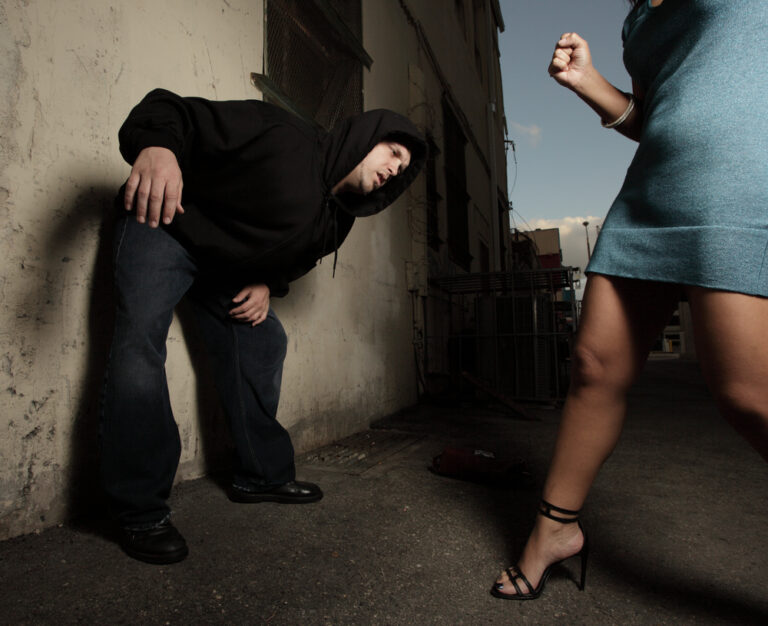
– Clearly protective: staggered feet, hands up near your face, chin tucked.
– Your body is saying, “I’m ready if you move in.”
– Used when a threat is imminent, and de-escalation has failed.
Mastering the transitions between these three states is where real skill lives. Your body should flow between them naturally—without hesitation—so your readiness feels like second nature.
Posture as a Deterrent
Predators look for easy targets. The way you stand can make them think twice.
• Stand tall, shoulders back – Confidence is a shield.
• Make appropriate eye contact – Show you see them.
• Keep hands visible – Ready hands mean you’re no surprise victim.
• Hold your ground unless tactically retreating – Backing away carelessly signals fear.
Your stance sends a powerful message: “I see you, I’m aware, and I am not an easy mark.”
Beyond the Physical: The Mindset Shift
Strong posture doesn’t just deter others—it changes you. It interrupts panic, quiets the “freeze” response, and sharpens thinking under pressure. Research even shows that confident stances can lower stress hormones and boost confidence.
Practice Until It’s Instinct
Knowing these stances isn’t enough—you must drill them.
• Scenario Training – Move from Neutral to Interview Stance when a stranger approaches, then to Defensive Stance if the threat escalates.
• Smooth Transitions – Focus on weight shifts, hand movement, head position, and breathing.
The goal: make the change so natural a bystander barely notices, but any potential predator does.
Stance + Voice = Power
When paired with strong verbal commands, your stance amplifies your message. A firm “STOP!” from a ready position carries authority that words alone cannot.
Final Thought
Physical readiness is about being alert, balanced, and instantly capable of action. It reduces vulnerability, boosts confidence, and prepares you mentally to act under stress.
At Krav Maga Essentials, we teach you to train the body, arm the mind, and trust both. When danger comes, it’s your mindset—rooted in practice and preparation—that turns fear into focused action.
“Train the body. Arm the mind. Survive with both.”