

“You can’t be afraid of the consequences. Getting hit is good for you.”
That line often makes people pause the first time they hear it in a Krav Maga class. It sounds counterintuitive. After all, the goal in self-defense is not to get hit. The goal is to stay safe, create distance, and escape danger.
But the deeper lesson isn’t about encouraging pain. It’s about removing the fear of pain that paralyzes people.
Fear of the consequence is often worse than the consequence itself.
I once saw this play out with a client of mine who, by most standards, would be considered fearless. He was an extreme sports skier who regularly traveled to Europe to helicopter to the tops of mountains and ski terrain that most people wouldn’t even consider standing on. These weren’t groomed slopes. These were expert-only descents where one mistake could mean a very bad day.
On top of that, he was in tremendous physical condition. Years of CrossFit training had turned him into an impressive physical specimen—strong, disciplined, and mentally tough.
By all outward appearances, this was someone who embraced risk.
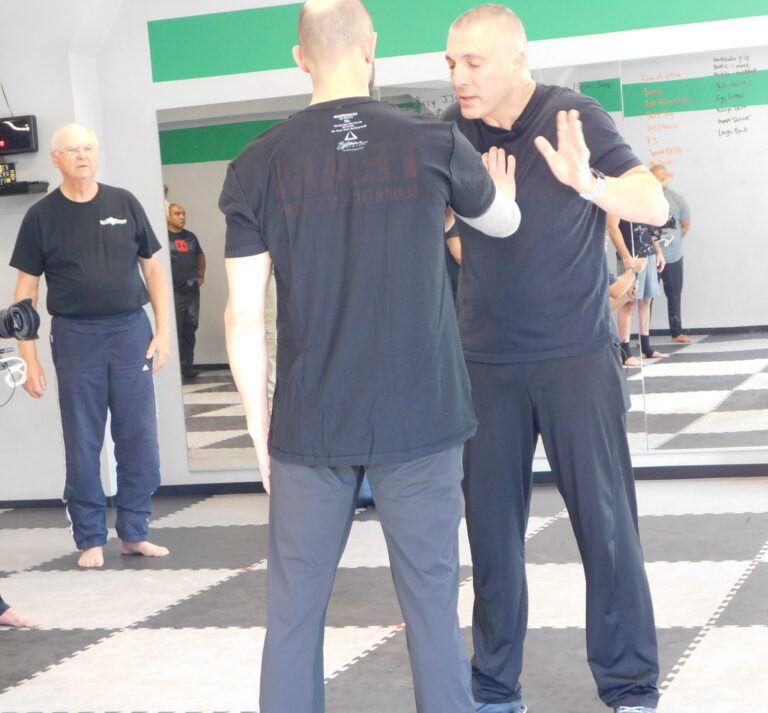
Yet during a training session we were working on blocking inbound punches. At one point he missed the block. I pulled the punch at the last moment so he wouldn’t get hit.
The look on his face was immediate and unmistakable—relief.
You could see that he had been anxious about the possibility of taking that punch.
It was an interesting moment. Here was a man who would willingly jump out of a helicopter onto a mountainside that could kill him if he made a mistake, yet the idea of getting lightly punched in a controlled training environment triggered real apprehension.
So I told him something that surprised him.
“In time,” I said, “one of my punches will probably come through and you will experience getting hit.”
That wasn’t a threat. It was a lesson.
When that moment eventually happens, it will likely be a liberating experience. Because what he will realize is that he can take a hit and continue. The fear of the consequence had been far greater than the consequence itself.
Interestingly, once I told him that, he finished that training session with me—and I never saw him again. He never returned to train.
Clearly, his anxiety about getting hit was greater than his desire to become safer in a self-defense environment.
On the mats I often see people wince or physically fade away from incidental contact. Their bodies instinctively retreat because they’re trying to avoid even the smallest amount of discomfort.
But that reaction comes with a cost.
Fear creates hesitation.
Hesitation kills action.
And in a real confrontation, hesitation can be far more dangerous than the strike you’re trying to avoid.
This doesn’t mean we train recklessly. Safety and control are always priorities. But we also recognize a simple truth.
Even the most practiced student—or instructor—of Krav Maga will probably take a hit at some point.
And when that happens, the lesson becomes clear.
You’re still standing.
You’re still thinking.
You’re still capable of responding.
The consequence you feared didn’t end you.
And in that realization comes a powerful shift: you discover you are far stronger than you thought.