

By now, two things should be clear.
Under pressure, your child won’t rise to the occasion. They’ll fall back on what they’ve practiced. And most kids haven’t practiced anything at all.
So the real question becomes: what exactly should they rely on?
Not random advice. Not scattered tips they vaguely remember. A framework — something simple, repeatable, and reliable when stress hits and thinking slows down.
Here’s what actually holds up.
1. Awareness First
Not paranoia. Just presence.
Awareness means noticing when behavior changes, when someone closes distance too quickly, when a tone shifts in a way that doesn’t match the situation. It means paying attention to the environment instead of moving through it on autopilot.
If something feels off, that feeling matters. The mistake most people make is waiting for confirmation before they act. By the time you’re certain something is wrong, you’ve already lost time you needed.
2. Permission to Act
This is the single biggest failure point — and the one no one talks about.
Your child feels something. Their instincts are firing. But they don’t act because they’re trying to be polite, avoid embarrassment, or not seem like they’re overreacting.
That hesitation is precisely where situations escalate. Acting on discomfort early is not overreacting. It’s the whole point.
3. Clear Boundaries
Not passive. Not hinted at. Not communicated through body language and hope.
Clear. Verbal. Direct. “No.” “Back up.” “I’m not interested.”
People who push boundaries are actively watching to see whether those boundaries will be enforced. If they’re not enforced clearly and immediately, they don’t exist as far as that person is concerned.
4. Movement and Positioning
Most self-defense training gets this wrong. It focuses on strength and technique while ignoring the one thing that matters most: where you are standing.
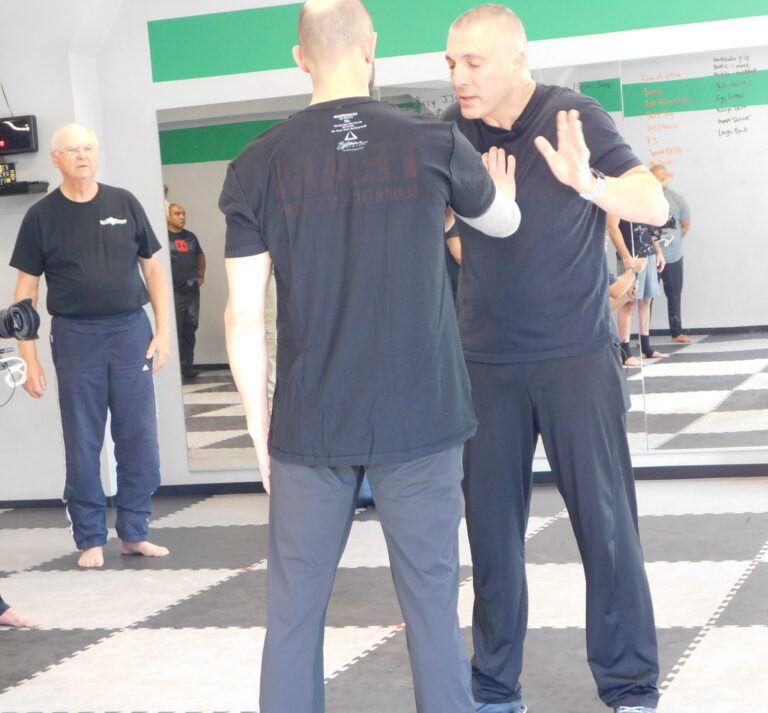
Real-world safety depends on position. Staying on your feet, creating space, keeping exits within reach. You don’t need to be stronger than the other person. You need to be in a better position.
5. Decisive Action If Necessary
If it turns physical, there is no middle ground and no half-measures.
The objective is not to win. It’s to disrupt the situation, create enough space, and escape immediately. That’s the entirety of the goal.
6. One Goal: Get Home Safe
Not proving a point. Not standing your ground. Getting home safe. Everything else is secondary.
Why This Works
Under stress, complex systems collapse. Simple systems hold.
This framework gives your child a reliable sequence they can move through without thinking — because when something is actually happening, there is no time to think.
This is exactly what we train at Krav Maga Essentials. Repeatedly, until every step becomes automatic.
The BaSix Program — kravmagaessentials.com